
Introduction
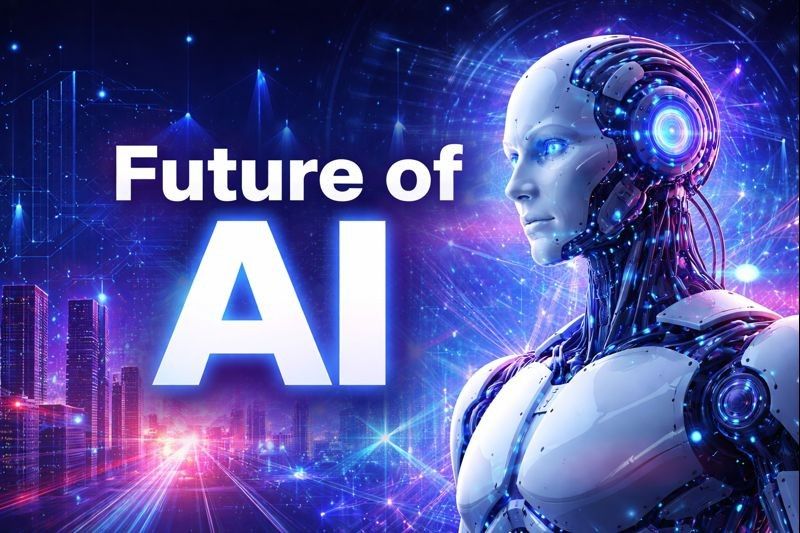
Artificial Intelligence is no longer an experimental technology reserved for research labs. It is already embedded in our phones, businesses, hospitals, and even creative industries. The future of AI will go far beyond automation—reshaping how humans think, work, and collaborate with machines.
According to research from the World Economic Forum (weforum.org), AI will be one of the most transformative forces of the next decade. In this article, we explore AI future predictions, key artificial intelligence trends, and how AI in the next 10 years will change the world in ways we are only beginning to understand.
AI Today vs. AI in the Next 10 Years
AI has evolved rapidly, but the next decade will bring exponential change.
| Area | AI Today | AI in the Next 10 Years |
|---|---|---|
| Intelligence | Narrow task-based AI | Context-aware adaptive AI |
| Automation | Rule-based | Intelligent automation |
| Creativity | AI-assisted | AI-generated creativity |
| Interaction | Commands & prompts | Natural conversations |
| Decision Support | Analytics | Predictive intelligence |
This evolution is already visible in reports from McKinsey & Company
(mckinsey.com).
Artificial Intelligence Trends Defining the Future
1. Machine Learning Evolution and Deep Learning Breakthroughs
The machine learning evolution is accelerating due to:
- Self-supervised learning
- Multimodal AI models
- More efficient deep learning technology
Research published by MIT Technology Review
(technologyreview.com) highlights that future AI systems will require less data while delivering higher accuracy.
This will dramatically expand AI future scope across industries.
2. Generative AI and the Creativity Revolution
The generative AI future marks a turning point in how content is produced. AI now generates:
- Articles and marketing copy
- Code and software
- Music, videos, and designs
Platforms built on large language models demonstrate how AI innovation is shifting creativity from manual execution to idea-driven collaboration. According to Stanford AI Index
(aiindex.stanford.edu), generative AI adoption is growing faster than any previous AI wave.
3. Automation and AI: From Efficiency to Intelligence
Automation and AI are moving beyond repetitive tasks. In the next decade, AI-powered systems will:
- Optimize logistics in real time
- Predict consumer behavior
- Automate strategic business decisions
This transformation is fueling massive AI industry growth, as outlined by IBM Research
(ibm.com/ai).
Impact of Artificial Intelligence on Jobs in the Next Decade
Will AI Replace Jobs?
The impact of artificial intelligence on employment is complex. While some roles will disappear, many will evolve.
According to the World Economic Forum Future of Jobs Report
(weforum.org/reports), AI will:
- Eliminate repetitive roles
- Create new jobs in AI governance and development
- Redefine existing professions
Skills Needed for the AI Era
To succeed in the future of artificial intelligence in the next 10 years, professionals must develop:
- Analytical thinking
- Data literacy
- Creativity and problem-solving
- Human–AI collaboration skills
Human and AI Collaboration: The Real Future
Rather than replacement, human and AI collaboration will define success. AI will act as:
- A co-pilot for professionals
- A research assistant for scientists
- A productivity enhancer for creators
This approach is already transforming workplaces, as highlighted by Harvard Business Review
(hbr.org).
Artificial General Intelligence (AGI): How Close Are We?
Artificial General Intelligence (AGI) aims to match human-level reasoning. While full AGI may still be beyond 2035, progress is rapid.
Experts from OpenAI and DeepMind suggest future AI systems will:
- Learn across domains
- Reason with context
- Adapt without retraining
These advancements signal a new phase in artificial intelligence development.
AI Ethics, Regulation, and Trust
With power comes responsibility. AI ethics and regulation are becoming global priorities.
Key concerns include:
- Data privacy
- Algorithmic bias
- Transparency
- Responsible automation
The European Union AI Act
(digital-strategy.ec.europa.eu) is one of the first comprehensive efforts to regulate AI responsibly.
How AI Will Transform Industries
Healthcare: Smarter, Faster, More Accurate
The future of AI in healthcare includes:
- Early disease detection
- Personalized treatment
- AI-assisted surgeries
The World Health Organization (WHO)
(who.int) confirms AI’s potential to improve global healthcare outcomes.
Education: Personalized Learning at Scale
The future of AI in education will focus on:
- Adaptive learning platforms
- Personalized student feedback
- Teacher support tools
According to UNESCO
(unesco.org), AI can democratize education worldwide.
Business and Enterprise Growth
AI future predictions for businesses include:
- Predictive analytics
- AI-powered customer support
- Data-driven intelligence
Organizations adopting AI early will dominate the next decade.
The Role of AI in Digital Transformation
AI is the foundation of modern digital transformation. Without AI:
- Data remains underutilized
- Automation stays limited
- Innovation slows
With AI, companies unlock real-time intelligence and scalable growth.
Benefits and Risks of AI in the Future
Benefits
- Increased productivity
- Smarter healthcare
- Faster innovation
- Better decisions
Risks
- Job displacement
- Ethical misuse
- Overdependence on AI
- Cybersecurity threats
Understanding the benefits and risks of AI in the future is essential for sustainable growth.
Conclusion
The future of AI is not about machines replacing humans—it is about redefining intelligence itself. Over the next decade, artificial intelligence will enhance creativity, reshape industries, and transform societies.
Those who adapt, learn, and collaborate with AI will lead the future.
Call-to-Action
💬 What do you think about the future of AI?
📩 Subscribe for weekly insights on AI trends
🔗 Explore our related articles on AI and future technology