

Introduction
Imagine you’re reading evening headlines over coffee — and suddenly, the world’s most earthquake-prone nation gets rocked. That’s exactly what happened on December 8, 2025, when a powerful seismic event hit off Japan’s northeastern coast. This “Japan Earthquake Update” brings you immediate facts, human stories, safety guidance, and what the world is doing in response. Whether you’re watching from thousands of miles away or planning for future resilience, the implications are global.
With recent history and tectonic realities, no one should be indifferent — so let’s dig deep into what unfolded, what we know now, and what every one of us can learn.
What Happened The 2025 Earthquake & Tsunami Warning
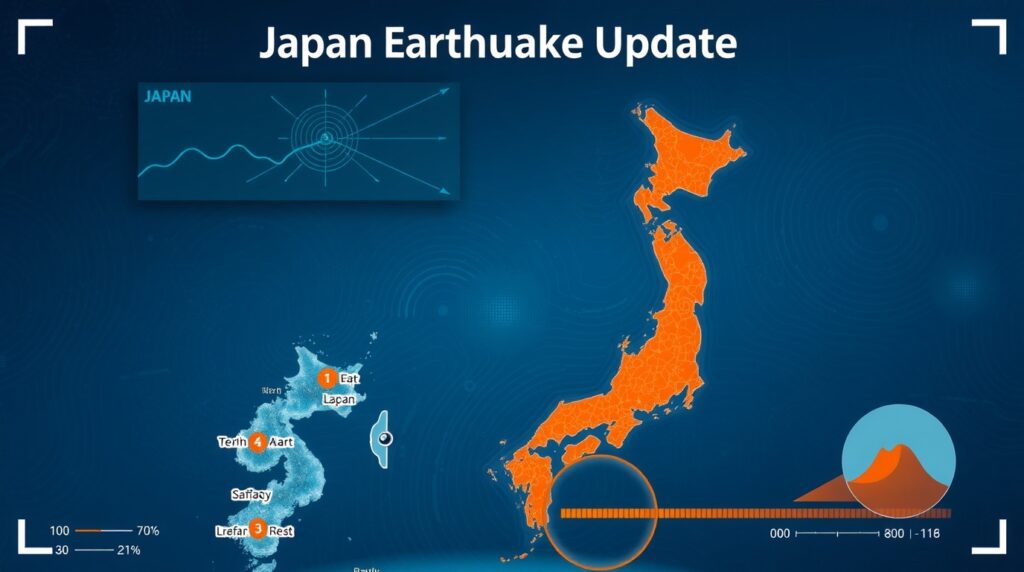
On the night of December 8, 2025, a major earthquake struck off the coast of eastern Aomori Prefecture, in the Pacific waters of northern Japan. The quake registered magnitude 7.6 by the Japan Meteorological Agency (JMA) and United States Geological Survey (USGS). The Japan Times+2Wikipedia+2
- The hypocenter lay around 50 km under the sea, approximately 80 km off the coast. The Japan Times+2Geo News+2
- In the city of Hachinohe (Aomori Prefecture), the shaking was rated “upper-6” on Japan’s 1–7 seismic intensity scale (shindo scale) — strong enough to make standing difficult, cause heavy furniture to collapse, and break windows and tiles. The Guardian+1
- Immediately, tsunami warnings were issued for coastal zones of Aomori, Iwate Prefecture, and Hokkaido, with waves up to 3 meters (≈ 10 feet) anticipated. The Japan Times+2Geo News+2
As a result, thousands were evacuated, rail and ferry services suspended, and 90,000+ residents were urged to head inland. The National+2The Japan Times+2
Though subsequent tsunamis observed at ports were smaller — between 20–70 cm — the fear and chaos during the first few hours underscored how real and unpredictable the threat remains. The Guardian+2AP News+2
Why Japan Faces Frequent Tremors — Tectonic Reality & Seismic Activity
The recent quake isn’t just a one-off; it’s part of a broader pattern rooted deep under Earth’s surface. The Washington Post+2Japan Meteorological Agency+2
Tectonic Setup: The Pacific Ring of Fire
- Japan sits at the intersection of four major tectonic plates, making it one of the world’s most earthquake-prone regions. The Washington Post+1
- This slab-boundary churn leads to intense seismic pressure — meaning earthquakes can occur frequently, sometimes every few minutes somewhere in Japan’s territory. The Washington Post+1
Recent Seismic Activity (2025)
- In July 2025 alone, near the southern Tokara Islands, a swarm of quakes began — including a 5.5-magnitude event registering “Shindo 6–” on the JMA scale. Japan Meteorological Agency+1
- Earlier this year, other regions including Miyazaki Prefecture and parts of southern Japan experienced quakes of magnitude 6.6 and 4–5 range, with minor tsunamis and occasional damage. Japan Meteorological Agency+2Dawn+2
So when a 7.6-magnitude quake hits — though dramatic — it’s unfortunately not a surprise. It is a painful reminder of an ongoing reality rather than a rare anomaly.
Impact & Human Stories — What the Numbers Don’t Tell
Even as official casualty reports remain limited (injuries but no confirmed fatalities so far), the human and infrastructural impact is real and unfolding. Wikipedia+2AP News+2
On Ground — Disruption & Panic
- In Hachinohe and surrounding cities, people reportedly “couldn’t stand” while the tremor lasted; many scrambled in darkness, trying to reach higher or stable ground. The Guardian+1
- Videos and eyewitness footage show furniture toppled, windows broken, and chaotic evacuations. India Today+2The Watchers+2
- Transport services — rail, ferries, some flights — were halted immediately. Residents spent the night in shelters, city halls, and temporary centers, unsure whether a second quake or tsunami wave might hit. The Japan Times+2Geo News+2
Tsunami Threat — Actual vs Projected Waves
- While initial warnings projected up to 3-meter tsunamis, actual measured sea surges were in the 20–70 cm range at many ports. The Guardian+2AP News+2
- Still, the mere possibility of repeated, stronger waves forced large-scale evacuations — a stark reminder that tsunamis remain among Japan’s biggest threats, even when early quakes themselves cause damage.
Human Cost & Community Anxiety
- Reports mention at least 17 injuries in initial hours, mainly due to falling debris, broken glass, or panic during evacuation. Wikipedia+1
- For many Japanese — especially in quake-prone coastal zones — this is not a one-time event but a recurring ordeal. Communities spoke of anxiety, fear of aftershocks, and the trauma of sudden displacement.
What’s Being Done — Disaster Response, Relief & Safety Measures
Emergency Alerts & Warnings
- The JMA and local governments issued tsunami warnings, evacuation orders, and emergency alerts immediately after the quake struck. The Japan Times+2Geo News+2
- Authorities urged residents to move “to higher ground or inland” and stay away from the coast until the all-clear was given. The Guardian+1
- The government also activated an emergency task force to assess damage, coordinate rescue operations, and support affected communities. AP News+1
Relief & Global Response
While local Japanese agencies are leading the immediate rescue and relief efforts, such large-scale disasters historically draw international humanitarian aid — from emergency medical support to logistical help for displaced populations. (Given the fresh timing of this quake, global relief mobilization is expected to scale in coming days.)
Preparedness and Long-Term Resilience
Experts continue to emphasize earthquake preparedness — from building codes to community awareness. The recent quake also underscores the importance of aftershock readiness, tsunami-evacuation routes, and early-warning systems in coastal and high-risk zones.
What You Can Learn — Safety Tips & Global Solidarity
Even if you live far from Japan, there’s a powerful takeaway: natural disasters demand preparedness and empathy. Here are some universal “earthquake & tsunami safety tips”:
- Always have an emergency kit: water, first-aid, flashlight, radio, important documents.
- Identify safe zones in your home — door frames, sturdy tables, or open spaces away from glass.
- If you’re near coastlines: know the evacuation plan, escape routes, and local alerts.
- Support trusted humanitarian organizations when relief efforts begin — help can be financial (donations), logistical, or even raising awareness.
And from a global citizen perspective: stay informed, share verified updates, and avoid spreading panic or unverified rumours.
Bigger Picture Why This 2025 Quake Matters
This recent event is more than just another entry in a seismic log. It serves as a renewed wake-up call — to communities in Japan and around the world — that:
- Living in a hotspot like the Pacific Ring of Fire comes with recurring seismic risk. The Washington Post+1
- Even powerful earthquakes don’t always lead to catastrophic tsunamis — but the possibility, and human instinctive fear, remain real.
- Preparedness, awareness, and swift disaster response can significantly reduce casualties and damage.
- Global solidarity and humanitarian response matter — because disasters seldom stay within borders.
Conclusion & Call to Action
The 2025 quake in Japan is a stark reminder that earthquakes — and their secondary threats like tsunamis — are unpredictable and often devastating. But they are also preventable tragedies, if communities stay prepared, governments act fast, and global awareness remains high.
If this post moved you, consider doing one (or more) of the following:
- Share this update to raise awareness among friends or family — you never know who might need it.
- Subscribe to reliable news and disaster-watch outlets for ongoing coverage.
- Support — or research — humanitarian aid efforts for affected Japanese communities.
Above all: stay alert, stay compassionate. Because disasters may come unannounced — but solidarity & preparation can make all the difference.