
Introduction
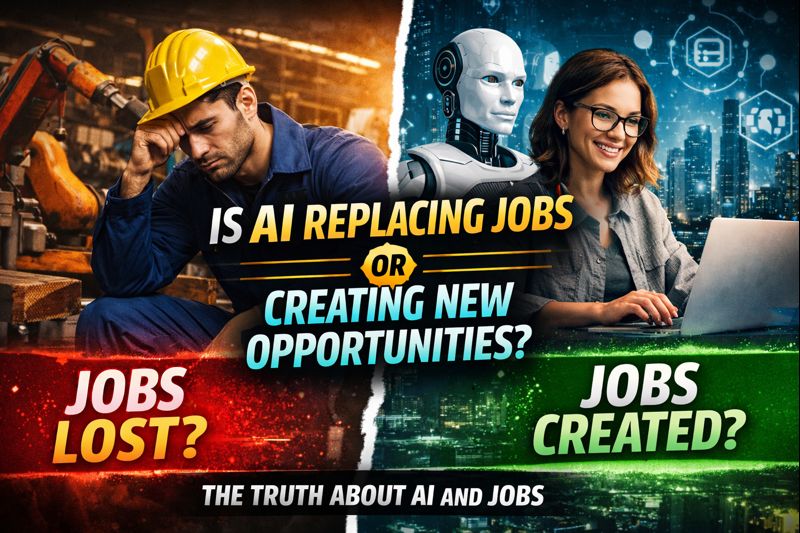
Artificial Intelligence is no longer a futuristic idea—it is already transforming how we work, earn, and build careers. From automated factories to AI-powered content tools, the conversation around AI and Jobs is everywhere. Some people believe AI is taking jobs away, while others see it as a powerful engine creating new opportunities.
So what is the real truth?
Is AI replacing jobs, or is it opening doors to better and smarter careers?
To understand the impact of AI on employment, we must move beyond fear-based headlines and look at real data, real trends, and how the job market is actually evolving.
How AI Is Replacing Certain Jobs (The Reality We Must Accept)
There is no doubt that AI replacing jobs is a real phenomenon—especially in roles based on repetitive, predictable tasks. Automation powered by artificial intelligence is now faster, cheaper, and more accurate than humans in many operational areas.
According to the World Economic Forum, automation is reshaping industries globally and redefining how work is done
👉 https://www.weforum.org
Jobs most affected by AI and automation include data entry roles, basic customer support, factory line work, telemarketing, and routine accounting tasks.
However, an important point often ignored is this:
AI replaces tasks, not human intelligence.
AI Is Also Creating New Job Opportunities at a Massive Scale
While some jobs are disappearing, the AI job market is expanding faster than ever. New roles are emerging that did not exist just a few years ago.
Research from McKinsey Global Institute shows that AI could create millions of new jobs globally by 2030
👉 https://www.mckinsey.com
High-demand artificial intelligence jobs include machine learning engineers, AI product managers, data scientists, automation specialists, AI prompt engineers, and AI ethics professionals.
This proves one thing clearly:
The future of jobs with AI is not about job loss—it’s about job transformation.
AI and Employment: Traditional Jobs vs AI-Driven Jobs
| Factor | Traditional Jobs | AI-Driven Jobs |
|---|---|---|
| Nature of Work | Repetitive & manual | Creative & analytical |
| Skill Demand | Limited | High & evolving |
| Career Growth | Slow | Fast |
| Job Security | Declining | Increasing |
| Income Potential | Fixed | Scalable |
This shift highlights how AI and employment are moving toward smarter, skill-based careers.
AI Workforce Transformation: Humans and AI Working Together
One of the biggest myths is that AI will completely replace humans. In reality, the most successful workplaces are built on human and AI collaboration.
For example:
- Marketers use AI tools for research and content ideas, while humans handle strategy
- Doctors use AI for diagnosis support, but final decisions remain human
- Developers use AI to speed up coding, not replace creativity
This collaboration is driving a massive AI workforce transformation across industries.
Digital Skills and AI: Why Reskilling Is the New Job Security
In the AI era, learning never stops. People who invest in digital skills and AI are the ones securing long-term career growth.
Platforms like Coursera and edX show rising enrollment in AI and machine learning courses
👉 https://www.coursera.org
👉 https://www.edx.org
Key skills in demand include:
- Machine learning fundamentals
- AI automation software
- Data analysis
- Generative AI tools
Reskilling for AI is no longer optional—it’s essential for survival in the modern job market.
Jobs That AI Cannot Replace Anytime Soon
Despite rapid advancements, there are many jobs that AI cannot replace because they rely on emotional intelligence, ethics, creativity, and leadership.
Examples include therapists, teachers, healthcare professionals, creative directors, and leadership roles. These professions require human judgment and empathy—qualities machines cannot replicate.
Generative AI Impact on Careers and Businesses
Generative AI is redefining productivity and creativity. Tools like ChatGPT, Midjourney, and Runway ML are helping individuals and businesses do more with less.
According to Harvard Business Review, generative AI is increasing efficiency and innovation across industries
👉 https://hbr.org
This shift is accelerating the AI-driven economy, where individuals can scale faster without large teams.
Will AI Take Jobs in the Future? The Honest Answer
So, will AI take jobs in the future?
Yes—but only from those who refuse to adapt.
History proves that every technological revolution creates more opportunities than it destroys. AI is no different. Those who learn to work with AI will stay ahead, while those who resist change may struggle.
Benefits of AI for Employment (Often Ignored)
AI brings multiple benefits to the workforce:
- Higher productivity
- Less burnout from repetitive work
- New remote and global job opportunities
- Faster business growth
- Better work-life balance
Rather than reducing human value, AI amplifies it.
Final Verdict
AI is not the enemy. Fear and lack of preparation are.
The impact of AI on jobs and employment depends entirely on how individuals respond. Those who upskill, reskill, and embrace AI will thrive in the future job market.
Conclusion
AI is reshaping the world of work, but it is also opening doors to opportunities never seen before. The real question is not whether AI is replacing jobs—it’s whether you are preparing for the future.
💬 Share your thoughts in the comments
📩 Subscribe for more AI and career insights
🔗 Share this article with someone worried about AI and job
The future belongs to those who start learning today.